
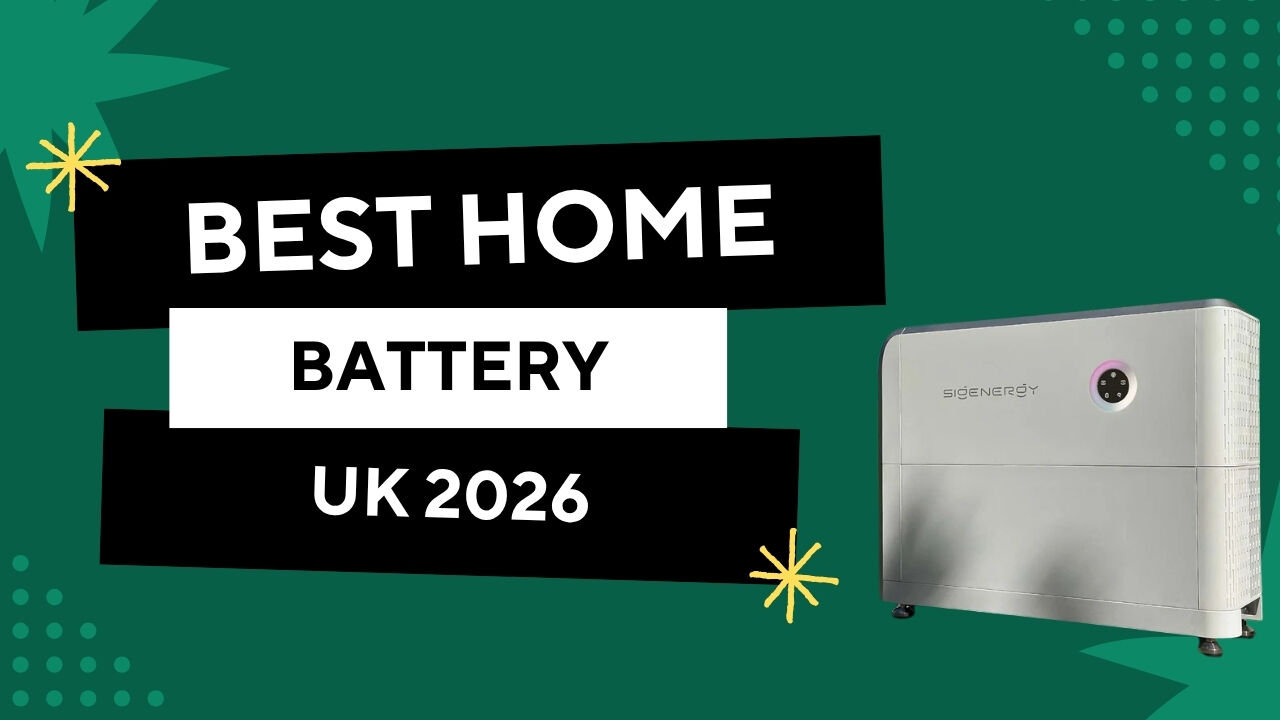
Sigenergy has gone from unknown to genuinely sought-after in UK homes in a short space of time, and we get asked about it more than any other battery brand we fit. This is an installer’s view rather than a spec-sheet summary — what the SigenStor actually does well, where it is the wrong answer, and what it costs fitted.
We are a Sigenergy approved installer and our own engineers commission every system, so what follows is based on fitting them, not reading about them.
What the SigenStor actually is
Most home batteries are one thing in one box. The SigenStor is a stackable tower that folds five things into a single unit:
- A solar inverter — so you do not need a separate hybrid inverter on the wall
- The battery itself — modular, 6 kWh or 9 kWh per module
- DC EV charging — built in, not a separate wallbox
- Whole-home backup — the house rides through a power cut
- Energy management — the system decides when to charge, store, export or send power to the car
That integration is the entire pitch. A conventional solar-plus-battery-plus-EV-charger install is three separate products from up to three manufacturers, three apps and three warranties. The SigenStor is one install, one app and one point of contact when something needs looking at.
Where it genuinely wins
It expands. You can start at a single module and add more later — one controller takes up to six, around 54 kWh. Very few systems let you buy what you need now and grow into it without replacing what you already own. If a heat pump or a second EV is somewhere in the next few years, that flexibility is worth real money.
The EV charging is properly integrated. Because the charging is DC and built into the tower, solar power reaches the car without the conversion step a standard AC charger has to make. If you have an EV and solar, this is the neatest way we know of to connect the two.
It is efficient. Peak efficiency is 97.6%, which is at the top of what we fit — and efficiency compounds quietly over every kWh that passes through the system for the next decade.
It looks like it was designed on purpose. That sounds trivial and is not, because a battery usually lives somewhere you can see it. It is IP66-rated, so it can go indoors or outside.
Where it is the wrong answer
If you just want the cheapest route into storage, this is not it. An all-in-one like the Fox ESS EVO starts at £4,500 fitted and does the fundamental job — charge cheap overnight, discharge at peak — perfectly well. If tariff arbitrage is the whole goal and there is no EV or heat pump in the picture, spending more on integration you will not use is a poor trade. We will tell you that.
If you want one fixed unit and nothing to think about, Powerwall is simpler. Tesla Powerwall 3 is 13.5 kWh in a single box with whole-home backup and no sub-board needed. There is no module-count decision to make. Some people want that.
The UK track record is shorter. Tesla has been here for a decade. Sigenergy has not. The engineering is excellent, but a shorter history means installer competence and warranty registration matter more, not less.
What it costs
We fit the SigenStor from £6,995 installed. Because the system is modular, the price follows the size you start at rather than a single fixed package — see the full battery cost table for how that compares with everything else we fit.
That figure is turnkey: the module or modules, the controller, all the electrical work, whole-home backup configuration, your Northern Powergrid G98 or G99 notification submitted for you, and the mySigen app commissioned with your tariff schedule already set. Domestic battery storage carries 0% VAT until 31 March 2027.
The bit most reviews miss: the tariff does the earning
A battery does not save money by existing. It saves money by moving your consumption from expensive electricity to cheap electricity, which means the tariff is doing at least as much work as the hardware.
On a time-of-use tariff you charge overnight at roughly 7–8p/kWh and avoid buying at 25–30p/kWh during the evening peak. That gap is the return. The SigenStor’s energy management optimises against your tariff automatically, which is genuinely useful — but only once you are on the right tariff in the first place. Our guide to the best time-of-use tariff in 2026 covers what each one actually pays.
If you export, Octopus Outgoing Fixed pays 12p/kWh from 1 March 2026 — worth knowing because a lot of comparison sites are still publishing the older, higher figure.
Our verdict
The SigenStor is the most genuinely integrated home energy system we install, and for the right house it is excellent: solar, storage, EV charging and backup in one expandable unit with one app. If you have or plan an EV, or you expect your energy needs to grow, it is the system we would point you at first.
If you want storage at the lowest sensible cost and nothing more, it is over-specified — and we would rather sell you the Fox ESS and have you happy than sell you the biggest thing on the price list.
Compare all three side by side on our home battery storage page, or see the SigenStor page for the full specification and what an install involves.