
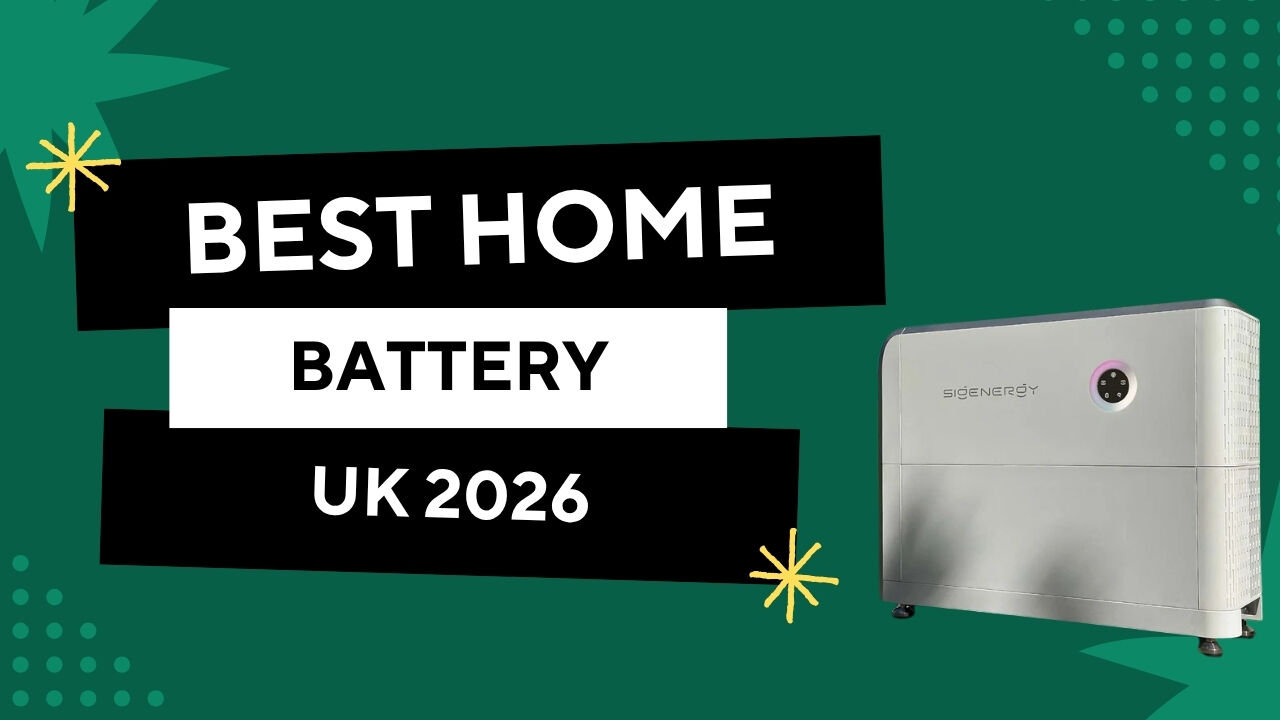
Seven battery platforms cover most of the UK residential market in 2026: Tesla Powerwall, Sunsynk, SolarEdge, Solis + Pylontech, Duracell, Enphase and Fox ESS. They all do the basics — store cheap overnight power, release it during peak hours, integrate with solar — but they differ meaningfully in warranty length, EPS backup, app quality and capital cost.
Here’s the honest comparison from an installer who fits all of them across the North East.
Best home battery 2026 at a glance
Best overall
Tesla Powerwall 3
13.5 kWh, whole-home backup, Tesla Energy Plan SEG access.
Best value £/kWh
Solis + Pylontech
£480/kWh installed (15 kWh stack). Modular, expandable.
Best for backup
Tesla Powerwall 3
Whole-home islanding standard. No critical-circuits sub-board needed.
Best for SolarEdge solar
SolarEdge BAT-10K
DC-coupled, panel-level optimisation, native mySolarEdge app.
Best modular
Sunsynk 5.32
Stack to 25 kWh in 5.32 kWh units. Open ecosystem, broad inverter support.
Full comparison table
| Battery | Usable kWh | Installed £ | £/kWh | Round-trip % | DoD % | Cycle warranty |
|---|---|---|---|---|---|---|
| Tesla Powerwall 3 | 13.5 | £8,500 | £630 | 89% AC | 100% | 10yr / unlimited |
| Sunsynk 5.32 | 5.32 (stack to 25) | £5,200 | £978 | 95% | 90% | 10yr / 6,000 cycles |
| SolarEdge BAT-10K | 10 | £6,800 | £680 | 94% DC | 100% | 10yr / 70% retained |
| Solis S6 + Pylontech US5000 | 4.8 (stack to 24) | £4,800 (5 kWh) / £8,200 (15 kWh) | £480 (15 kWh) | 90% AC | 95% | 10yr / 6,000 cycles |
| Duracell Dura5 | 5 | £4,000 | £800 | 96% | 100% | 10yr / 6,000 cycles |
| Enphase IQ Battery 10T | 10.5 | £7,900 | £752 | 96% | 98% | 10yr / 6,000 cycles |
| Fox ESS EP5 | 5.18 (stack to 25.9) | £4,600 | £888 | 95% | 95% | 10yr / 6,000 cycles |
| Best for | Tesla: backup. Solis: value. SolarEdge: SE solar. Sunsynk: modular. Duracell: entry. Enphase: micros. Fox: AC retrofit. |
Tesla Powerwall: premium, with the Tesla Energy Plan
Tesla Powerwall sits at the premium end of the market — significantly more expensive than the alternatives, but with three features no other mainstream battery can match.
Whole-home backup as standard. During a power cut, every circuit in the house stays live automatically — no separate critical-circuits sub-board, no manual switching. The Powerwall ships with a Backup Gateway that handles the islanding transition seamlessly.
Tesla Energy Plan SEG access. Tesla Powerwall is the only battery eligible for the Tesla Energy Plan, which currently pays up to 24p/kWh for solar export — the highest rate in the UK market by some margin. For homes with significant solar export, this is worth £200–400/year more than the next-best SEG tariff.
Polished aesthetics. The 13.5 kWh unit is visually integrated — wall-mounted, sleek, Tesla-branded. For garage installations where the battery is on display, this matters.
The downside. Capital cost is the highest of any mainstream UK battery. 13.5 kWh is sometimes overkill — a 3-bed semi rarely uses more than 8 kWh per evening — so the extra capacity sits idle most days. Closed ecosystem: no OCPP-equivalent for third-party tariff integration.
Best for: Homes with large solar arrays (8kW+) generating significant export. Customers who specifically want whole-home backup. Premium-spec installs where aesthetic and brand matter.
Sunsynk 5.32 — the modular open-ecosystem alternative
Sunsynk is a South African brand that has earned a strong UK following on the strength of genuinely open-protocol hybrid inverters and modular 5.32 kWh battery cabinets. We’ve fitted Sunsynk on homes in Newcastle, Sunderland and Durham where customers wanted Tesla-style expandability without Tesla pricing.
Modular expansion. Start with one 5.32 kWh cabinet, stack up to five units (26.6 kWh) on a single hybrid inverter as needs grow. No retiring of existing modules.
Open ecosystem. Sunsynk hybrid inverters talk to most third-party tariff optimisers and home-energy-management systems via Modbus — useful for power-user customers who want to dispatch the battery against their own logic, not just the manufacturer app.
95% round-trip efficiency. Among the highest in the table. Over a 10-year life on daily cycling that’s a real number — roughly £300 more electricity through the system vs an 89% AC-coupled equivalent.
The downside. App is functional but plain — no Storm Watch, no slick visualisations. UK installer base is smaller than Tesla or Solis. Warranty support runs through your installer rather than direct from Sunsynk UK, so pick an installer that will be there in year 8.
Best for: Customers who want to start small and expand. Solar-heavy households planning a phased rollout. Anyone who wants open-protocol control over their battery dispatch.
SolarEdge Home Battery: for SolarEdge solar customers
SolarEdge’s home battery is designed to integrate tightly with SolarEdge solar inverters and panel-level optimisers. If you’re installing fresh solar with a SolarEdge inverter, their battery is the natural complement.
DC-coupled efficiency. Most home batteries are AC-coupled — energy flows panel → inverter (DC→AC) → battery (AC→DC) → home (DC→AC). Each conversion loses 2–3% efficiency. SolarEdge’s DC-coupled battery skips the intermediate steps. Net effect: roughly 1–2% more usable energy through the system over its lifetime.
Panel-level optimisation. SolarEdge’s signature feature is per-panel power optimisers, useful for partially-shaded roofs. The battery integrates into the same monitoring framework.
The downside. Locked-in to SolarEdge — you can’t easily switch inverter brand later without abandoning the battery. Smaller UK installer base than Tesla or Solis. We recommend it specifically where the panel-level optimisation is genuinely needed.
Best for: Homes with significant roof shading where panel-level optimisation pays off. New solar + battery installs as a unified SolarEdge system.
Solis + Pylontech: budget-conscious option
The Solis hybrid inverter paired with Pylontech batteries is the value-conscious choice. Solid kit, well-supported, but with less polish than the premium brands.
Lowest capital cost. Typically 30–45% below an equivalent Tesla Powerwall install. £4,800 for a 5 kWh starter and £8,200 for a 15 kWh stack are achievable today.
Hybrid inverter included. Solis hybrid inverters handle solar + battery + grid in a single box. For new solar + battery installs, the integration is clean.
Pylontech battery modules. Industry-standard format used across multiple inverter platforms. Modular — stack additional capacity later without retiring existing kit.
The downside. Solis Cloud app is functional but less polished than the Tesla app. Customer-facing support runs through the installer rather than direct from the brand. Critical-circuits EPS only — no whole-home backup option.
Best for: Budget-conscious new solar + battery installs. Cases where capital constraint matters more than premium features.
Duracell Dura5 & Enphase IQ — the new entrants
Two newer arrivals on the UK residential market that we now stock and install.
Duracell Dura5 (5 kWh, £4,000 installed). The Duracell brand needs no introduction; the Dura5 cabinet itself is a LiFePO4 wall-mount unit with a 10-year, 6,000-cycle warranty and 96% round-trip efficiency. Pitched as the cheapest installed battery in the table and a sensible entry point for a 3-bed semi running Octopus Go. AC-coupled, so it retrofits to any existing solar inverter (or runs standalone). The trade-off is capacity — 5 kWh is one evening of peak avoidance for most homes; expand by adding a second unit rather than expecting one to do everything.
Enphase IQ Battery 10T (10.5 kWh, £7,900 installed). Enphase’s micro-inverter solar customers now have a native battery option that slots cleanly into the same Enlighten monitoring app. 96% round-trip efficiency, 98% depth of discharge and whole-home backup capability via the IQ System Controller. The architecture (microinverters per battery module) means a single cell failure doesn’t take the whole stack offline — meaningful long-term reliability story. Best for existing Enphase solar households or new builds where per-panel-level granularity matters.
Real £/kWh comparison (installed, North East)
The headline price doesn’t tell the full story — what matters is cost per usable kilowatt-hour over the warranty period. Here’s the same seven batteries normalised to £/kWh installed in our North East service area.
| Battery | Installed £ | Usable kWh | £/kWh installed | £/kWh after 10yr cycling |
|---|---|---|---|---|
| Solis + Pylontech (15 kWh) | £8,200 | 15.0 | £547 | £0.15 |
| Tesla Powerwall 3 | £8,500 | 13.5 | £630 | £0.17 |
| SolarEdge BAT-10K | £6,800 | 10.0 | £680 | £0.19 |
| Enphase IQ 10T | £7,900 | 10.5 | £752 | £0.21 |
| Duracell Dura5 | £4,000 | 5.0 | £800 | £0.22 |
| Fox ESS EP5 | £4,600 | 5.18 | £888 | £0.24 |
| Sunsynk 5.32 | £5,200 | 5.32 | £978 | £0.27 |
Per-kWh costs fall sharply as the stack grows — a single 5 kWh Sunsynk cabinet looks expensive at £978/kWh, but a four-cabinet 21 kWh Sunsynk stack on a single hybrid inverter lands closer to £580/kWh. The same compounding works for Solis + Pylontech and Fox ESS.
Real installs across the North East
A snapshot of what we’ve actually fitted in the past 12 months across the AMP service area (Northumberland, Tyne & Wear, Durham, Teesside):
- Tesla Powerwall 3 — installs concentrated in Jesmond, Gosforth, Tynemouth, Darras Hall and Yarm. Customer profile: 8kW+ solar arrays, EVs on the drive, willing to pay the premium for whole-home backup.
- Solis + Pylontech — our highest-volume battery, installed across every town in the patch from Newcastle and Sunderland through to Stockton and Middlesbrough. Most common spec is 10 kWh AC-coupled retrofit on existing solar.
- SolarEdge BAT-10K — exclusively on homes where we’ve fitted SolarEdge solar inverters, typically in Newcastle, Durham and Stockton where shaded roofs justify per-panel optimisation.
- Sunsynk — growing share in Sunderland, Gateshead and South Shields among power-user customers who want open-protocol control.
- Duracell Dura5 — recent additions in Washington, Chester-le-Street and Houghton — customers running Octopus Go standalone, no solar.
- Enphase IQ 10T — small but growing — heritage Enphase solar households in Newcastle and Tynemouth retrofitting their first storage.
- Fox ESS — modular AC-coupled retrofit option, fitted across Teesside and Darlington.
Specific install counts and customer references available on request — we publish a reviews and case studies page with current data.
How we pick for AMP customers
Our default recommendation by use case:
“I want the best battery, money no object.” Tesla Powerwall — for the whole-home backup and Tesla Energy Plan access alone.
“I want the best value for money.” Solis + Pylontech — solid LFP kit at a meaningfully lower price.
“I’m installing fresh SolarEdge solar.” SolarEdge Home Battery — the DC-coupling and panel-level optimisation add up.
“I already have a Tesla EV / want unified Tesla ecosystem.” Tesla Powerwall — the app integration with the car is genuinely useful.
“I have older solar and want to retrofit a battery.” Tesla Powerwall (AC-coupled), Solis-paired Pylontech, Duracell Dura5 or Fox ESS EP5 — all retrofit cleanly to any existing solar inverter.
“I want to start small and expand.” Sunsynk 5.32 or Solis + Pylontech — both genuinely modular without retiring early modules.
The questions to ask any installer
If you’re getting quotes from multiple installers, these questions sort the good ones from the rest:
-
“Which inverter are you proposing and is it listed on the Energy Networks Association G98/G99 type-test register?” Solar inverter manufacturer matters. Avoid no-name Chinese inverters; they save £200–400 capital cost and cost you in unreliability later.
-
“What’s the EPS configuration and what does the backup runtime look like?” A vague “yes it has backup” is not enough. You want specifics on what circuits stay live and for how long.
-
“Is the install going to include a tariff switch?” Most installs perform much better on Octopus Go or similar. Installers who don’t actively help with the tariff switch are leaving most of the savings on the table.
-
“What’s the warranty process if something fails?” A real installer will have warranty replacement procedures in place. We typically replace failed in-warranty units within 5–7 working days from initial fault report.
-
“Can you show me an install you did 18+ months ago?” Anyone can install a battery. Maintaining one over years is a different challenge. Reference checks on older installs are revealing.
Frequently asked questions
Which home battery is best for me in the UK in 2026? It depends on whether you have solar yet. New solar + battery same-install: Tesla Powerwall 3 has the lowest total installed cost because it includes the solar inverter built-in. Existing SolarEdge solar: SolarEdge BAT-10K integrates natively. Existing AC-coupled retrofit (any inverter brand): Solis S6 + Pylontech is the cheapest per kWh. Budget standalone storage: Duracell Dura5 at £4,000 installed is the entry point.
How much does a home battery cost installed in 2026? Tesla Powerwall 3 £8,500; SolarEdge BAT-10K £6,800–£9,500; Solis + 5 kWh Pylontech £4,800; Solis + 15 kWh Pylontech £8,200; Sunsynk 5.32 £5,200; Duracell Dura5 £4,000; Enphase IQ 10T £7,900; Fox ESS EP5 £4,600. All include certification, smart meter sign-off and 10-year warranty.
How long do home batteries last? LiFePO4 home batteries are rated for 6,000–10,000 full cycles, equating to 16–27 years of daily cycling. Warranties guarantee 70% capacity retention at 10 years. Most batteries we’ve replaced in the field have lasted 12–15 years before noticeable degradation.
Do I need solar to install a home battery? No. Storage works standalone on a time-of-use tariff (Octopus Go etc.) — charge overnight at 7–9p, discharge at peak 25–28p. Saves £400–£800/yr. With solar, payback shortens to 4–7 years.
Which battery has the best app? Tesla, by a wide margin — real-time flow, 5-minute historical charts, Storm Watch. Enphase Enlighten is next-best. SolarEdge mySolarEdge is solid. Pylontech is basic; users monitor via Solis Cloud. Sunsynk and Fox ESS apps are functional but utilitarian.
What is EPS and which batteries support it? EPS = Emergency Power Supply: the battery isolates from grid during a cut and powers your circuits from storage. Whole-home: Tesla Powerwall 3, Enphase IQ 10T (with System Controller). Critical-circuits: SolarEdge BAT-10K, Solis + Pylontech, Sunsynk, Fox ESS, Duracell.
Can I install a battery without changing my solar inverter? Yes via AC coupling — the battery has its own inverter and connects on the AC side. Tesla Powerwall 3, Enphase IQ 10T and Duracell Dura5 AC-couple cleanly. Trade-off is round-trip efficiency: 88–90% AC-coupled vs 94–96% DC-coupled hybrid.
Bottom line
For premium UK home battery customers in 2026, Tesla Powerwall is the answer — it’s the only option with whole-home backup standard and Tesla Energy Plan SEG access. SolarEdge is the right answer for SolarEdge solar customers specifically. Solis + Pylontech is the value-conscious choice. Sunsynk is the open-ecosystem modular choice. Duracell, Enphase and Fox ESS round out the entry-level and retrofit market.
We install all seven — happy to recommend the right one for your specific setup during the free survey.
Related: Smart Export Guarantee explained 2026 · Solar panel cost UK 2026 · Home battery storage service page