
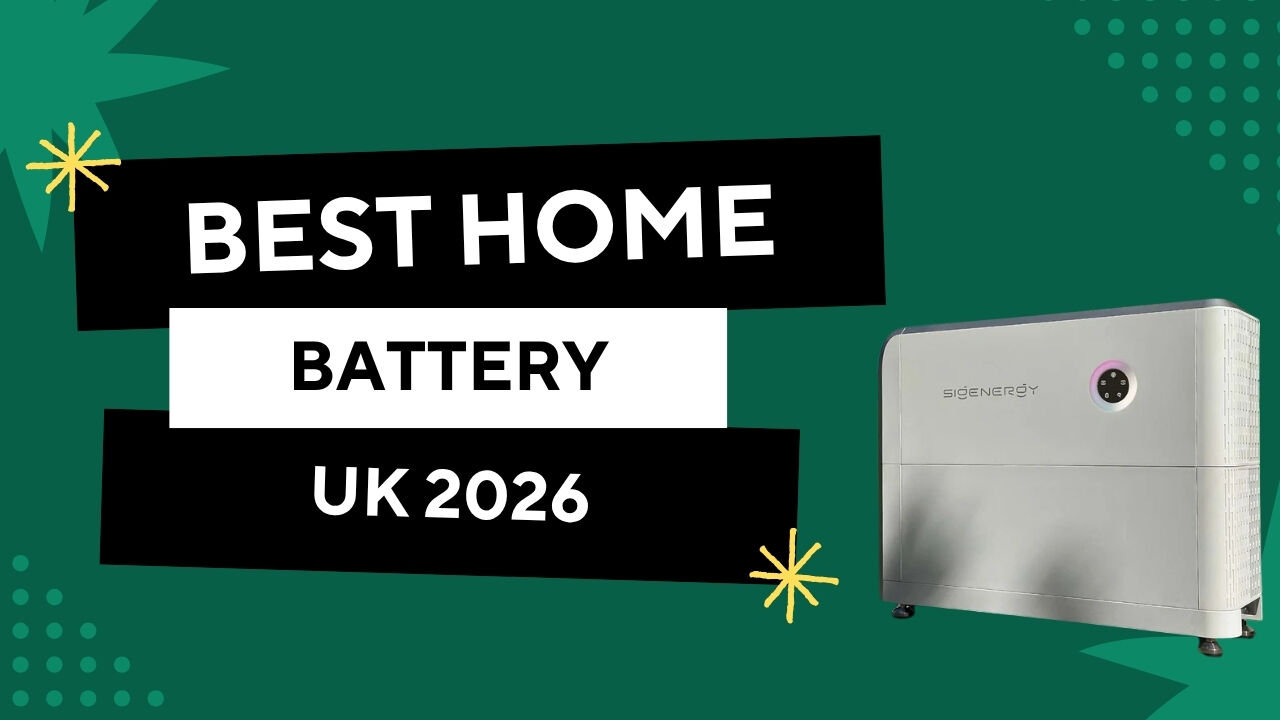
“How much is a Sigenergy?” is the question we get asked before any other, and the honest answer starts with a caveat: the SigenStor is modular, so it does not have one price the way a single fixed unit does. What it has is a starting point and a set of things that move it.
The starting price
We fit the SigenStor from £6,995 installed. Every battery we fit, with its own from-price, is on the battery cost table so you can see where that sits.
That figure is turnkey, not a hardware price with the install bolted on afterwards. It covers:
- The SigenStor module or modules you start with, plus the SigenHybrid controller
- DC EV charging wired in, if you want the car fed straight from the roof
- All electrical work, and the whole-home backup configuration
- Your Northern Powergrid G98 or G99 notification, submitted for you
- mySigen commissioned on your phone with the tariff schedule already set
- AMP’s 12-month workmanship guarantee on top of the manufacturer warranty
Domestic battery storage carries 0% VAT until 31 March 2027, and that is already in the price.
What moves the price
Capacity, most of all. Modules come in 6 kWh and 9 kWh, and one controller takes up to six of them — around 54 kWh at the top end. Starting bigger costs more; that is the whole of it. What is unusual about the SigenStor is that starting smaller does not lock you out of getting bigger later.
Whether you want the EV charging. DC charging is built into the tower rather than added as a separate wallbox. If you have an electric car this is usually the reason people choose the system in the first place — but if you already have a charger you are happy with, it is capacity you may not need.
Whether solar is going on at the same time. Fitting solar and storage together is nearly always cheaper than doing them in two visits, because the scaffolding, the electrical work and the DNO paperwork happen once.
How much backup you want. Whole-home backup asks more of the install than holding up a handful of critical circuits.
The property itself. Cable runs, consumer-unit condition, and whether the tower is going indoors or outside. It is IP66-rated, so both work.
Is it worth the premium over a cheaper battery?
Sometimes, and we will tell you when it is not.
If your goal is straightforward tariff arbitrage — charge cheap overnight, discharge at the evening peak, no EV, no heat pump on the horizon — then the integration you are paying for on a SigenStor is integration you will not use. The Fox ESS EVO starts at £4,500 fitted and does that core job well. We would rather fit that and have you recommend us.
The SigenStor earns its premium when you want more than one thing from the system: solar, storage, EV charging and backup in one unit, with room to grow. At that point you are not comparing it to a battery, you are comparing it to a battery plus an inverter plus a wallbox from three manufacturers — and the gap narrows considerably.
Against Tesla Powerwall 3 at £8,995 the comparison is different again, and worth reading properly: SigenStor vs Powerwall 3.
The part that actually decides your return
The hardware sets what is possible. The tariff sets what you earn.
A battery makes money by shifting consumption from expensive electricity to cheap electricity. Overnight rates of roughly 7–8p/kWh against an evening peak of 25–30p/kWh are where the return lives, and the SigenStor’s energy management optimises against that automatically once you are on the right tariff. Our guide to the best time-of-use tariff in 2026 covers what each one pays.
If you export, Octopus Outgoing Fixed pays 12p/kWh from 1 March 2026. A number of comparison sites are still publishing the older, higher rate, so it is worth checking any payback sum you have been shown against the current figure.
Getting a real number
Everything above is a starting point, and a starting point is not a quote. What we do instead is survey the property free of charge, look at how you actually use energy across a day, and put one fixed written price in front of you — itemised, with the DNO route named, and no estimate hiding inside it.
See the Sigenergy installer page for the full specification and what an install day involves, or ask us for a quote.