
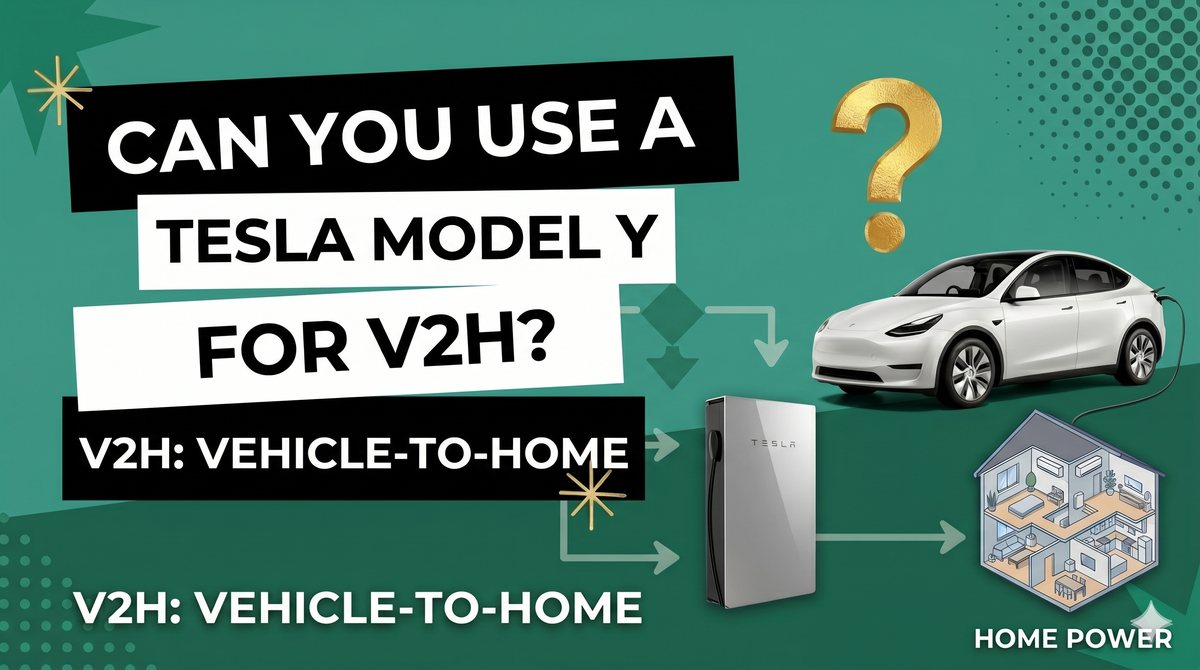
This one comes up almost every week. Someone has ordered a Model Y, they have seen a clip of an EV running a kettle or backing up a house during a power cut, and they want to know: can I get an adapter and do that with my Tesla?
The short answer is that the Model Y is, frustratingly, one of the weakest cars on the UK market for this. Not because Tesla cannot build the tech — they can — but because of how they have chosen to roll it out. Let us walk through exactly what your Model Y can and cannot do in 2026, and what actually works instead.
First, the three things people muddle up
Almost every confused conversation about “using your EV to power things” is really about three very different capabilities. Get these straight and the whole topic clicks into place.
V2L (vehicle-to-load) — a socket off the car. Plug a kettle, a fridge, power tools or a tent heater straight in. No wiring, no permission needed. It is just a handy socket.
V2H (vehicle-to-home) — the car wired into your consumer unit, powering the house through your normal sockets and lights. This needs a bidirectional charger and a capable car. It is whole-home backup.
V2G (vehicle-to-grid) — the car selling power back to the grid at peak times for credit. This needs special hardware and a supporting energy tariff.
The leap from V2L to V2H is the big one. V2L is just a socket on the car — simple and safe. V2H means feeding electricity back through your home’s fixed wiring, which needs a bidirectional charger, the right car, and proper grid-safety isolation. There is no adapter that bridges that gap. This is the single most common misunderstanding we hear.
So what can a 2026 Model Y actually do?
Only V2L — and only on some trims. As of June 2026, Tesla has added vehicle-to-load to the refreshed Model Y Performance and the six-seat Model Y L. It runs at roughly 2.2–2.4 kW through a Tesla outlet adapter — enough for a fridge, a kettle (just), a few lights or power tools. Genuinely useful for camping or a short power cut, but it is a single socket, not your house.
Here is the catch most buyers do not spot until it is too late:
| Model Y trim (UK) | V2L (socket) | V2H / V2G |
|---|---|---|
| Standard Range RWD | No | No |
| Long Range RWD | No | No |
| Performance | Yes — ~2.4 kW | No |
| Model Y L (six-seat) | Yes — ~2.2 kW | No |
The mainstream RWD and Long Range RWD — the cars most people in the UK actually order — get nothing. And this is not a setting waiting to be switched on: the standard cars use older power-conversion hardware, so an over-the-air update will not unlock V2L on them. If V2L matters to you, it has to be the Performance or the L, bought new.
Pro tip: If a salesperson or forum post tells you your standard Model Y will “get V2L in a future update,” be sceptical. The capability is tied to physical hardware the RWD and Long Range RWD do not have. Buy the car for what it does today, not a promised unlock.
Can I just buy a bidirectional adapter or charger for it?
No — and this is worth being really clear about, because the internet is full of half-truths.
You will find third-party plug-in adapters (brands like Tlyard, EVniculus and Teslaunch) that pull a few kilowatts of AC out of a Tesla’s charge port. These are real and fairly cheap, but they only do V2L — a portable socket. They do not power your home, they are unofficial, reliability varies by trim and software version, and Tesla says damage from third-party bidirectional adapters is not covered by your warranty. They are not a back door to V2H.
You may also have seen reports of a Tesla being made to discharge at higher power into a home setup. Those are one-off demonstrations, not products you can buy. As of now there is no purchasable bidirectional charger of any brand that officially works with a Tesla for V2H or V2G. Tesla simply has not enabled it — and they point owners towards a Powerwall instead.
What about Tesla’s “Powershare”?
Powershare is Tesla’s proper home-backup system — and it is Cybertruck-only, sold only in North America. The Cybertruck is not road-legal or sold in the UK, so even the one Tesla that can do V2H cannot be bought here. Tesla’s growing UK energy presence (the Powerwall, plus a new electricity-supply licence) is all about the home battery and tariffs — none of it makes your car power your home.
What works instead — three honest options
Realistic in the UK right now:
- A home battery (for example a Tesla Powerwall 3, around £8,500–£12,000 installed) — the simplest, most reliable backup, and 0% VAT until March 2027.
- A V2H-capable EV such as the Kia EV9 or Hyundai Ioniq 5, paired with a bidirectional charger like the Wallbox Quasar 2.
- Pairing either of the above with solar, so you are storing your own free energy rather than just shifting tariff hours.
Won’t work, despite the hype:
- Any Model Y backing up your home — no trim, no adapter, no charger.
- A third-party adapter “unlocking” V2H or V2G on a Tesla.
- Waiting for a software update to give a standard Model Y V2L.
- Buying a Cybertruck for Powershare in the UK — it is not sold here.
If your real goal is keeping the lights on in a power cut, or storing cheap overnight and solar energy to use at tea time, a battery is almost always the better answer than the car anyway — it is always plugged in, it does not drive off in the morning, and it is a mature, supported product. That is the route we fit most often, and we are happy to talk you through whether it is worth it for your home. Take a look at our battery storage and EV charging options, or just give us a call.
Pro tip: One nuance worth knowing if you ever do go down the V2H or V2G route: it is exporting power that triggers the paperwork, not the car itself. Anything that sends meaningful power back to the grid needs your network operator’s sign-off (a G99 application) before it is switched on. A good installer handles all of this for you.
For the full picture across every car and charger — not just Tesla — see our companion guide: V2H and V2G in 2026: using your EV as a home battery.
Related: V2H and V2G explained · full V2H compatible cars list · Best home battery UK 2026 · EV chargers