
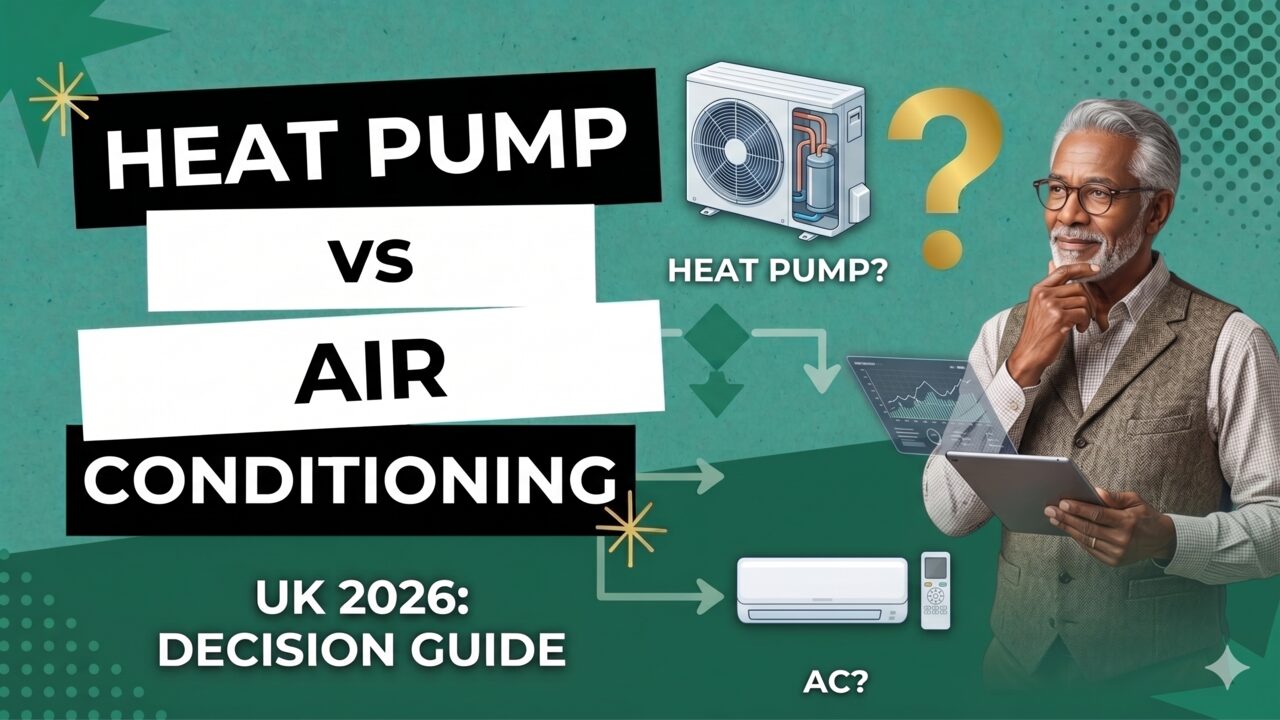
The UK terminology around “heat pumps” causes regular confusion. Strictly speaking, your air conditioner is also a heat pump — it uses the same vapour-compression refrigeration cycle, the same refrigerants, the same compressors. The difference is what they heat and how they distribute it.
Here’s how to choose between them.
Same technology, different jobs
Air conditioning in UK usage means air-to-air heat pumps. The outdoor unit (condenser) sits on a wall or ground outside. Refrigerant pipework runs to an indoor unit (typically wall-mounted). The indoor unit exchanges refrigerant heat with room air via a small fan and coil. Each indoor unit heats or cools one room.
Heat pumps in UK usage means air-to-water heat pumps. The outdoor unit is similar but bigger (5-15 kW typical). It exchanges heat with a water loop that flows through radiators, underfloor heating, and a hot water cylinder. One outdoor unit heats the whole house plus all the hot water.
The same compressor technology. Different distribution. Different jobs.
Cost comparison: installed and over 10 years
Air conditioning (air-to-air heat pump):
- Single-room split: £1,500-£2,500
- 4-zone whole-house: £6,000-£9,500
- BUS grant: not eligible
- Annual running cost (cooling + supplementary heating): £400-£800
- 10-year total cost: £10,000-£17,500
Air-to-water heat pump:
- 3-4 bed whole-house: £11,000-£14,000
- BUS grant: £7,500
- Net install cost: £3,500-£6,500
- Annual running cost (whole-house heat + DHW): £550-£900
- 10-year total cost: £9,000-£15,500
Gas boiler (for comparison):
- New combi boiler: £2,500-£4,000
- Annual running cost: £1,200-£1,800
- 10-year total cost: £14,500-£22,000
The headline finding: air-to-water heat pumps and AC have comparable 10-year economics — the BUS grant largely closes the upfront cost gap, and the AC’s slightly lower running cost partially offsets its lack of grant. Both beat gas boilers significantly over 10 years.
Heating performance: where they diverge
For whole-house heating, air-to-water heat pumps win.
A 3-bed UK home loses heat at roughly 4-7 kW on a -1°C design day. Air-to-water heat pumps are sized to deliver that whole-house load through your existing radiators, with one outdoor unit running consistently. The system is designed around your home’s actual heat loss, not around individual room comfort.
Air conditioning (air-to-air) can heat individual rooms efficiently but struggles at whole-house level:
- Each indoor unit heats one room — open-plan kitchens with hall connections lose heat to adjacent unheated zones
- Bedrooms typically heated to 18°C (sleep comfort), living to 21°C — but AC zone control isn’t always granular enough to handle this transition
- AC indoor units run at higher flow temperatures than air-to-water radiator water — they heat fast but cycle on/off frequently, which feels less comfortable than a constant-temperature radiator
- No hot water — you still need a gas boiler or immersion to heat DHW
For single-room cooling, AC obviously wins (heat pumps can’t cool through your radiators, only via UFH in cooling-capable models). For single-room supplementary heating, AC is competitive — particularly in bedrooms where the wall-split AC’s quiet operation (19-22 dB) beats radiator boom/click.
Cooling: AC’s home turf
UK summers have warmed significantly. Sustained 28-32°C heat is now a 2-3 week annual norm, not a once-in-a-decade event. Air conditioning solves this in a way no heat pump can.
Air-to-water heat pumps can run in cooling mode in some configurations:
- Through underfloor heating loops (Vaillant aroTHERM plus, Mitsubishi Ecodan QUHZ — but cooling capacity is modest, typically only enough to drop room temperature 3-4°C below ambient)
- Through fan-coil units (mostly commercial — fan coils dispense the chilled water into the room via a fan, but the unit cost approaches an AC split)
For useful residential cooling, you want air-to-air AC — typically a wall-split in the master bedroom (priority) and optionally a second zone in the main living area.
The BUS grant difference
The £7,500 Boiler Upgrade Scheme grant is restricted to air-to-water and ground-source heat pumps replacing fossil-fuel boilers. Air-to-air AC is excluded.
This is a regulatory choice — the BUS targets fossil-fuel boiler replacement specifically, and AC doesn’t displace your existing gas or oil boiler from the property (you typically keep it for hot water at minimum).
The £7,500 grant materially changes the heat-pump-vs-AC economics:
- Without grant: AC install (£6,000-£9,500) is cheaper than air-to-water (£11,000-£14,000)
- With grant applied: air-to-water net cost (£3,500-£6,500) becomes the cheaper option
If you’re a UK homeowner replacing an aging gas boiler anyway, the BUS-eligible air-to-water route is usually the most economic. If you’re keeping your existing boiler and want to add cooling + supplementary heating to specific rooms, AC wins.
Honesty about COP and efficiency
You’ll see efficiency figures (SCOP — Seasonal Coefficient of Performance) quoted everywhere. Both technologies are roughly equivalent in real-world UK conditions:
Air-to-air AC heating mode:
- SCOP 4.0-4.5 (premium Mitsubishi, Daikin)
- Slight efficiency advantage from direct refrigerant-to-air exchange (no intermediate water loop)
Air-to-water heat pump:
- SCOP 3.0-4.0 (typical residential ranges)
- 3.0 = high-flow-temp radiator system (older homes)
- 3.5-4.0 = low-flow-temp radiators or UFH (newer homes, retrofit with emitter changes)
- Lower than AC because of the intermediate water loop (5-10% efficiency cost)
Both beat:
- Gas boiler: ~0.92 efficiency (combustion is the limit)
- Oil boiler: ~0.88
- LPG boiler: ~0.92
- Electric storage heater: 1.0 (resistance heating — straight kWh in = kWh out)
A heat pump delivering SCOP 4.0 effectively turns 1 kWh of electricity into 4 kWh of heat. A gas boiler turns 1 kWh of gas into 0.92 kWh of heat. So the heat pump is roughly 4.3× more efficient per kWh of input energy — but you pay 4× more for electricity than gas per kWh, so the running cost advantage narrows. With the right tariff (Octopus Cosy for heat pumps), the running cost gap widens again.
When to choose AC
- You want summer cooling (no other technology delivers this for residential)
- You want supplementary heating in 1-3 rooms (master bedroom + lounge typical)
- You’re keeping your gas/oil boiler for hot water + whole-house heating
- You have a smaller flat or apartment where whole-house heat pump retrofit isn’t practical
- You want to spread the cost (start with single-room, add zones over years)
When to choose an air-to-water heat pump
- You’re replacing an aging gas, oil or LPG boiler anyway
- You want to qualify for the £7,500 BUS grant
- You want a single appliance for whole-house heating + DHW
- You have radiators or UFH already (avoids retrofit complexity)
- You want the highest-grade carbon reduction (whole-house decarbonisation)
When to install both
- You’re decarbonising your whole-house heating AND want to handle increasingly hot UK summers
- The combination — air-to-water heat pump + 1-2 AC zones — is the most future-proof setup for UK homes in 2026
The typical install sequence: air-to-water heat pump first (claim the BUS grant before it changes), then 1-2 AC zones added 6-12 months later. Both can be installed by the same MCS-certified team in one visit if you’d rather not stage them.
The Heat Geek + F-Gas combination
This is one of the few residential renewable choices where you need two distinct certifications: MCS for the heat pump install and F-Gas for the AC install. Most installers do one or the other; very few do both.
We hold both. We design and commission air-to-water heat pumps to Heat Geek methodology (which dramatically improves real-world performance) AND we F-Gas certify our AC installs. This means we can advise on both options honestly — we’re not steered toward one because it’s the only thing we sell.
If you’d like a survey covering both options for your property, book a free quote — we’ll show you the 10-year cost comparison on your actual house, not a generic table.