
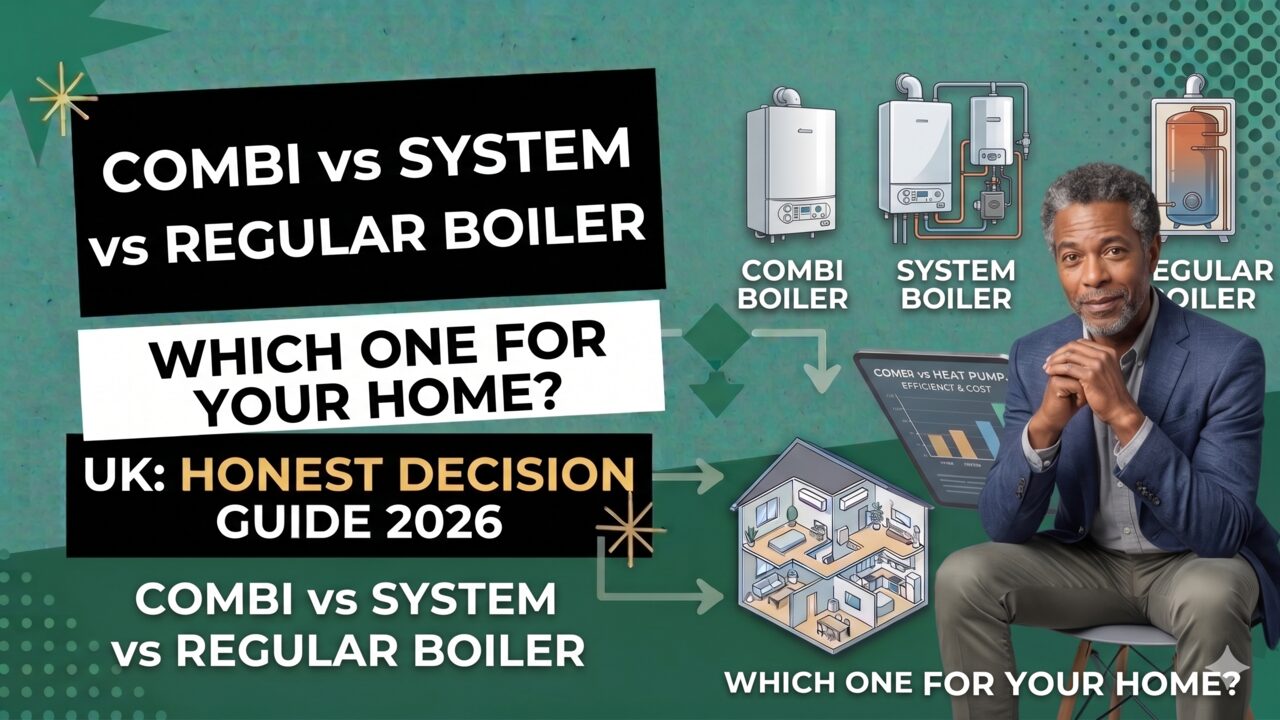
The combi-vs-system-vs-regular decision is the most consequential boiler choice for UK homeowners — gets it wrong and you’ll either spend years with poor showers or pay more than necessary for hot water. Here’s the 2026 decision framework.
The three types in one sentence each
Combi boiler: heats water on demand from the mains supply, no hot-water cylinder or cold-water tank needed.
System boiler: heats a hot-water cylinder (typically in an airing cupboard) plus the central heating, with expansion vessel built into the boiler unit.
Regular boiler (also called “heat-only” or “conventional”): heats a hot-water cylinder plus central heating, with a separate cold-water tank in the loft (vented system).
When combi is right (most UK homes)
The combi suits roughly 70-80% of UK residential properties:
✓ 1-3 bedroom flats or houses with 1-2 bathrooms ✓ Mains water pressure ≥1.5 bar (typical for most postcodes) ✓ Households where you rarely run 2 hot taps simultaneously ✓ Owners prioritising minimum space (no cylinder, no loft tank) ✓ Owners prioritising minimum standing heat loss (no stored hot water = no waste)
Combi advantages:
- Cheapest to install: £2,200-£3,500 typical
- Smallest footprint: boiler unit only, no cylinder
- Unlimited hot water: never runs out — keeps heating until you turn the tap off
- Most energy-efficient: no cylinder heat loss (~£40-£90/year saved vs system/regular)
- Quickest service / repair: common boiler, every Gas Safe engineer can service
Combi disadvantages:
- Lower flow rate for simultaneous taps (one shower max + minor sink draw)
- Initial cold-water wait when you turn a hot tap on (heat exchanger needs to warm up — 5-10 litres typically)
- Below 1.5 bar mains pressure: lukewarm shower problem
- No backup if mains water stops flowing (no stored water reserve)
When system is right (3-5 bed homes with high simultaneous demand)
System boilers suit ~15% of UK residential:
✓ 3-5 bedroom houses with 2-3 bathrooms ✓ Households that run 2 showers simultaneously (morning rush hour) ✓ Mains pressure below 1.5 bar where you want consistent hot water at any flow rate ✓ Owners who already have a vented cylinder and want to remove the cold-water tank ✓ Larger families where one bath fills while another shower runs
System advantages:
- Strong simultaneous flow: cylinder delivers stored hot water at any rate the cylinder is rated for (often 12-20 L/min — twice combi’s typical 8-12 L/min)
- No cold-water tank in loft: simpler plumbing, frees loft space
- Reliable in low-pressure areas: stored hot water doesn’t depend on mains flow rate
- Hot water backup: if mains fails briefly, cylinder still delivers
System disadvantages:
- Higher install cost: £2,800-£4,200 typical
- Cylinder space requirement: typically airing cupboard or utility room
- Standing heat loss: stored cylinder loses 1-2 kWh/day of heat to the surroundings
- Reheat time: if you drain the cylinder, 30-45 minutes to refill
When regular is right (large homes + heat-pump pathway)
Regular boilers suit ~5-10% of UK residential:
✓ 5+ bedroom houses with 3+ bathrooms and existing vented system ✓ Listed buildings where structural changes are restricted (keeping existing pipework is essential) ✓ Owners planning a future air-to-water heat pump (regular config integrates cleanest) ✓ Owners with existing functioning cold-water tank in loft — keep it ✓ Properties with very poor mains pressure where vented system gravity-feed is the only reliable option
Regular advantages:
- Highest hot-water flow rate: vented cylinder delivers at any rate combined with separate cold-water tank gravity feed
- Most heat-pump-compatible: buffer tank + cylinder layout works directly with air-to-water heat pumps
- Often cheaper than system: if you’re keeping existing pipework
- Resilient: loft tank holds 200-400L cold-water reserve
Regular disadvantages:
- Most maintenance: loft tank needs annual check, cylinder coil needs descaling
- Loft tank space requirement: can’t move it without major work
- Standing heat loss: as system boiler
- Risk of leak from loft tank: if the F&E tank overflows, water enters the ceiling (rare but possible)
Sizing — getting the kW right
Combi sizing depends on number of bathrooms + simultaneous demand:
| Property | Recommended kW combi |
|---|---|
| 1-bed flat | 24-28 kW |
| 2-bed flat / small 2-bed house | 24-28 kW |
| 3-bed semi (1 bathroom) | 28-30 kW |
| 3-bed semi (2 bathrooms) | 30-32 kW |
| 4-bed detached (2 bathrooms) | 30-35 kW |
| 4-bed detached (3 bathrooms) | 35-40 kW |
System / regular boiler sizing depends on heat load + cylinder size:
| Property | Heat load | Cylinder | Boiler kW |
|---|---|---|---|
| 3-bed semi | 8-12 kW | 150-180 L | 24-28 kW |
| 4-bed detached | 12-16 kW | 180-210 L | 28-32 kW |
| 5-bed detached | 16-22 kW | 210-300 L | 32-40 kW |
Common mistake: oversizing combi (e.g. 40 kW in a 3-bed semi). The boiler short-cycles (rapid on/off as central heating demand is too small for the minimum modulation rate), causing premature wear and slightly worse efficiency.
Sizing matters: use the BS EN 12831 heat loss calculation, not “kW per room” rules of thumb. We do this for free during your survey.
Future-proofing: which works with a heat pump?
If you might add an air-to-water heat pump in 5-10 years:
| Current setup | Heat pump retrofit difficulty |
|---|---|
| Regular boiler + vented cylinder | Easy — heat pump replaces boiler, cylinder coils stay (sometimes upgraded), F&E tank decommissioned |
| System boiler + unvented cylinder | Medium — heat pump replaces boiler, cylinder usually upgraded to a heat-pump-compatible model (200-300L typical) |
| Combi boiler only | Hard — heat pump needs a buffer tank (50-100L) + cylinder (200-300L), neither of which combi homes typically have space for. Means adding a cylinder room or extending existing space. |
If you’re certain you’ll never go to a heat pump: combi is fine. If you’re 50/50 or likely to install a heat pump within 10 years: system or regular makes the future-proofing easier.
Honest mid-range pricing for 2026
| Type | Installed cost | 12-year warranty cost (if applicable) | Annual service cost |
|---|---|---|---|
| Combi (Worcester/Vaillant 28kW) | £2,400-£3,200 | £200-£400/yr service contract | £85-£135 standalone |
| System (Worcester/Vaillant 30kW + 180L cylinder) | £2,800-£4,200 | Same warranty terms as combi | Same service cost |
| Regular (Worcester/Vaillant 30kW + 180L cylinder + tanks) | £2,600-£4,000 | Same warranty | Same service cost |
The £200-£600 spread between types reflects:
- Number of installation days (combi 1 day, system 1-1.5, regular 1-2)
- Cylinder cost (£500-£900 for 150-210L)
- Existing infrastructure (cheaper if you’re keeping existing tanks/pipework)
If you’d like an honest survey covering all three options for your specific home, book a free quote — we’ll size correctly per BS EN 12831, quote each option, and explain the heat-pump implications without any pressure to upsize.